The photographs that appear in editorials and campaigns are the visible result of substantial work that the photographs themselves don't show. The viewer sees the final image; what produced it remains invisible. This essay is about what the actual work consists of — the work that doesn't appear in the photographs but that determines whether they exist at all.
The hours before the camera
A fashion shoot day typically begins long before the camera comes out. Hair and makeup take 2-4 hours depending on the editorial direction. The model arrives early, sits while teams of stylists work, becomes the surface on which the editorial vision will be realized.
This time is part of the work. The model who can sit through hours of preparation without restlessness, who can engage with the stylists' choices without resistance, who can arrive at the moment of being photographed already in the right state — that capacity is part of what makes specific models reliably bookable.
The hours before the camera are usually invisible to anyone outside the production. They're also where much of the work's difficulty lies.
The conversation with the photographer
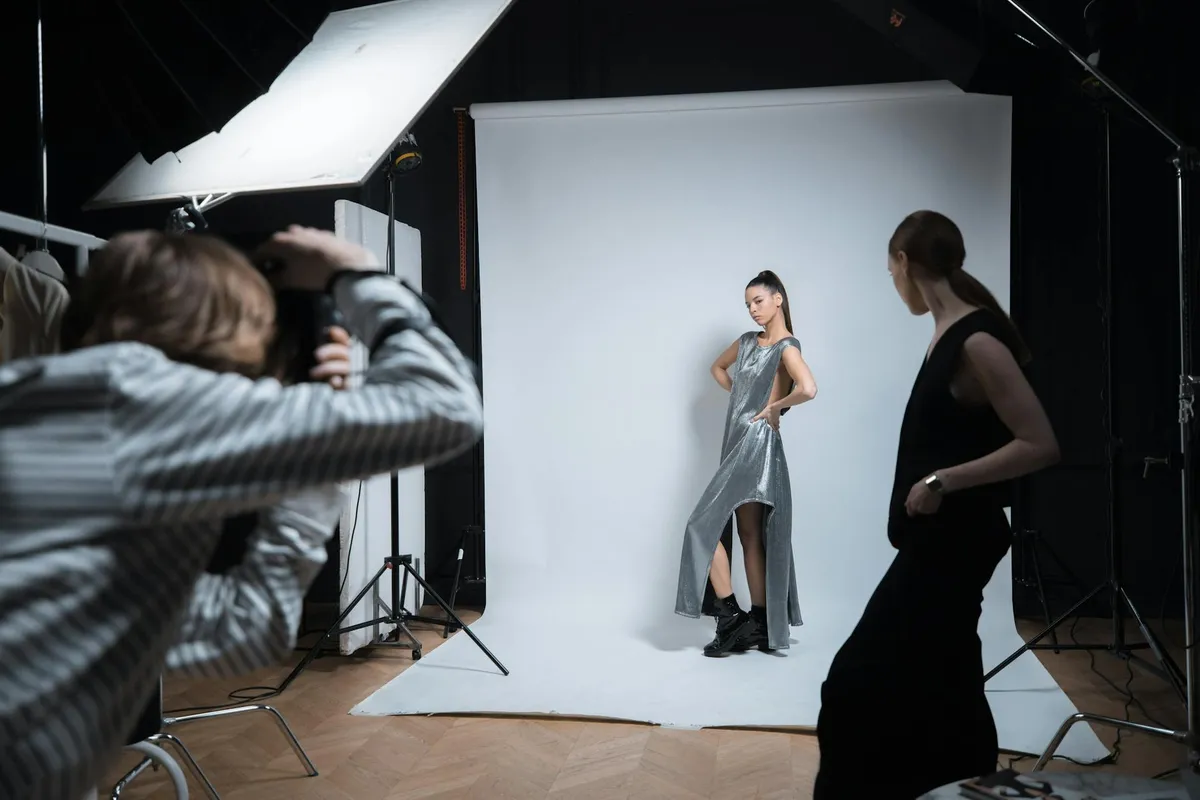
The shoot itself is partly a conversation. The photographer signals direction; the model adjusts. Subtle shifts of position, expression, energy. The good shoots happen through this back-and-forth more than through explicit direction.
Models who can read photographers' implicit signals work better than models who require explicit verbal direction. The reading isn't mystical; it's a learned skill developed through hundreds of shoot days. Photographers move their hands a certain way; the model adjusts. The photographer's breathing changes; the model knows to hold or to release.
This conversation is the actual creative work of the shoot. The photographs are the residue of it.
The physical control
What appears as effortless presence in photographs is usually substantial physical control. Holding a position for the time it takes for the photographer to find the right exposure. Maintaining facial expression while the body shifts. Producing motion that reads cleanly in still images rather than blurring.
The control is built through practice. Models early in their careers can't maintain positions or expressions the way models with years of practice can. The difference is invisible in finished photographs but obvious to photographers and stylists during shoots.
This physical work is athletic in ways the public image of modeling doesn't convey. By end of shoot day, the body has worked.
The emotional work
Producing the right emotional quality for photographs requires emotional access. The photographer wants longing; the model needs to find longing. The photographer wants joy; the model needs to find it.
This emotional work is exhausting in its own way. Producing emotional states on demand for hours isn't pure performance — it requires actually accessing the emotional material. The actor's relationship to character has parallels in the model's relationship to expression.
Models who can produce emotional range on demand work more than models who can't. The capacity isn't universal; some models simply can't access certain emotional registers consistently. The casting reflects this.
The professional reliability
Beyond the work itself, the professional reliability matters. Showing up on time, prepared, in good condition. Working within the production's constraints without drama. Maintaining relationships with the team across shoots.
This reliability is part of why specific models work consistently. The talent matters; the reliability often matters more. Photographers and stylists book the people who deliver consistently across many shoots, not necessarily the people who would deliver the most extraordinary single shoot.
The reliability is itself work — maintaining the lifestyle, sleep, fitness, and emotional stability that allow consistent delivery. The work outside shoot days enables the work during shoot days.
The agency relationships
Behind every working model is an agency relationship that produces the bookings. The work of maintaining that relationship — staying in regular contact, accepting and declining bookings appropriately, navigating the agency's commercial concerns — is part of the broader work of a modeling career.
Models with strong agency relationships work more than models with weaker relationships, even when the talent is comparable. The relational work matters.
The public dimension
For models with public visibility, additional work emerges around social media, public appearances, and the public-facing aspects of the career. This work is often invisible to the model's family and friends, who see only the polished public output.
The hours of content creation, image curation, response to public attention — all are work in addition to the modeling itself. Models who manage this dimension well produce more sustainable careers than those who don't.
The post-shoot work
After shoots conclude, additional work continues. Image selection conversations with the publication or client. Negotiation about which images can be used and where. Sometimes reshoots when initial results don't meet the editorial vision.
The model usually has limited control over this phase but is affected by its outcomes. Images that don't make publication don't exist for the public; images chosen for emphasis shape the model's visible portfolio.
Why this matters
Understanding the actual work has implications for how the industry should be evaluated. The visible images are the output; the work that produced them is much more substantial than the images suggest.
For people considering modeling careers: the work is real and substantial. The career rewards genuine professional commitment, not just appearance or natural talent. The models who sustain careers across years are typically those who treat the work as work.
For people studying or working with the industry: the invisibility of the work creates misunderstanding about what models actually do. Better understanding of the work produces better professional engagement with models and better evaluation of the industry's structures.
The closing observation
The photographs that emerge from fashion shoots are residue of substantial invisible work. The models who do that work well across years build sustainable careers; the models who can't produce the invisible work alongside the visible work tend to have shorter careers.
For viewers encountering finished photographs, awareness of the work behind them produces fuller understanding of what they're seeing. The photographs are the surface; the work that made them is what the industry actually consists of.